

User research is no longer a differentiator for Product, UX, and Design teams. Today, it's part of the routine for companies that need to make faster decisions and reduce risks in digital development.
But there is a problem that is starting to appear as research grows within companies: operating research at scale has become a challenge.
Manual recruitment. Unplugged tools. Arm-wrestled scheduling. Individual incentives. Insights scattered across multiple documents.
In practice, many teams have found that the biggest bottleneck in research is not in the method. It's in the operation.
It is within this context that ResearchOps emerges.
What is ResearchOps?
ResearchOps is the operational framework that allows user research to happen in an organized, scalable, and continuous manner within companies.
The term comes from “Research Operations” and gained strength mainly in UX Research, Product, and Design teams.
In practice, ResearchOps involves all the necessary infrastructure to enable research efficiently.
This includes:
- Participant recruitment
- calendar management
- incentive payments
- insight storage
- centralization of studies
- Process standardization
- Data governance
- ROI tracking
- Operational automation
In other words: while researchers focus on generating insights, ResearchOps ensures the entire operation runs smoothly.
Why has ResearchOps become important?
In recent years, research has come to occupy a more strategic space in companies.
Product Teams started validating decisions with users before launching features. Designers began testing experiences more frequently. And leadership realized that making decisions without contact with real users increases costs and risks.
The problem is that most companies have grown using makeshift processes.
In many cases, the research flow happens like this:
- Briefing in a tool
- recruitment elsewhere
- calendar agenda
- spreadsheet incentive
- scattered recordings
- insights in separate documents
It works at first. But it stops working when the volume increases.
That's why so many companies have started structuring research operations.
The biggest problem with research is not methodology
There is a common perception that the challenge of research lies in learning more sophisticated methods.
But in practice, many teams already know how to do research.
What's blocking the operation is something else:
- difficulty recruiting participants
- long wait to schedule interviews
- High no-show rate
- Operational rework
- manual processes
- lack of integration between tools
- difficulty keeping up with results
When this happens, the research loses speed.
And speed matters.
In digital companies, a delayed sprint can mean weeks of impact on product, marketing, and revenue.
How does a ResearchOps operation work?
A ResearchOps operation organizes the entire research journey into a single operational flow.
This normally involves:
Participant recruitment
Find people with the ideal profile for each study.
This is one of the biggest bottlenecks in research in Brazil, especially in specific niches.
Automated scheduling
Synchronize schedules between participants and researchers without manual message exchange.
Incentive Management
Participant payment with traceability and operational control.
Centralization of studies
Organize interviews, recordings, documents, and insights in a single environment.
Learning repository
Building a research memory to avoid rework and knowledge loss.
Metrics and ROI
Operational monitoring to understand speed, study volume, and research impact.
Why did the Brazilian market start looking into ResearchOps?
A large portion of the ResearchOps tools available today was created for international markets.
This creates difficulties for Brazilian companies, such as:
- unsupported platforms in Portuguese
- payment in dollars
- Absence of PIX
- Limited recruitment in Brazil
- flows not well adapted to the local reality
At the same time, UX Research maturity has grown in the country.
More companies have started investing in:
- Product teams
- strategic design
- continuous discovery
- Hypothesis validation
- user experience
The result is a market that needs local infrastructure for research.
ResearchOps does not replace researchers
One of the most common mistakes is thinking that ResearchOps replaces research or completely automates human work.
Actually, the goal is the opposite.
ResearchOps reduces operational overhead so researchers can spend more time on analysis, strategy, and decision-making.
The less manual effort involved in operations, the more room the team gains to generate value.
The future of research depends on infrastructure
The evolution of user research doesn't just depend on better methods.
It depends on more efficient operations.
In the same way that technology areas needed infrastructure to scale development, research teams have started to need infrastructure to scale learning.
This is precisely the scenario in which ResearchOps platforms have begun to gain traction.
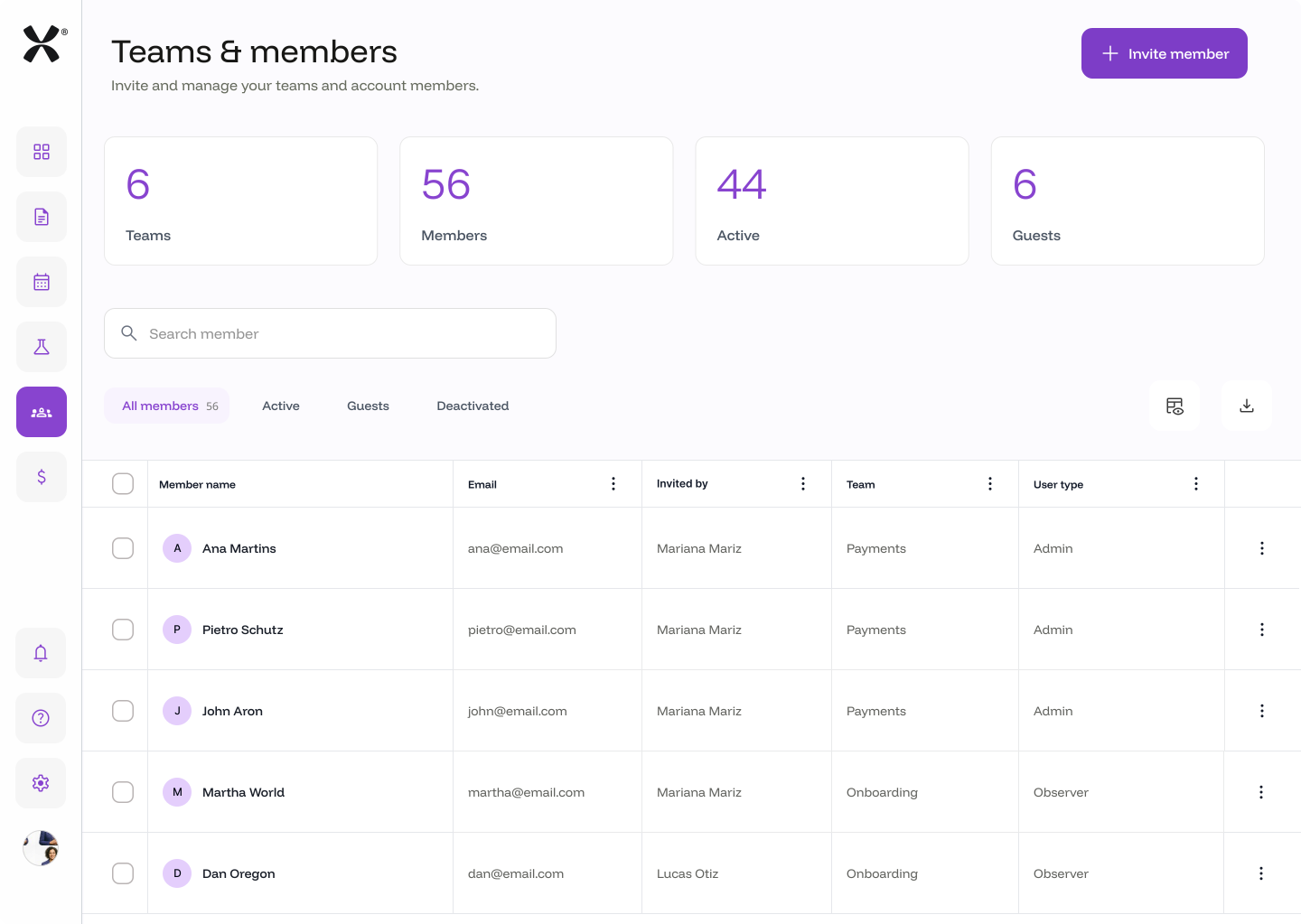
A userx was born with this objective: to centralize recruitment, scheduling, incentives, study conduction, and operational management in a single system designed for the Brazilian reality.
Because research grows when there is a process.
More research scales when there is infrastructure.